Home lyrics by Phillip Phillips, 8 meanings Home explained, official 2024 song lyrics
Table Of Content
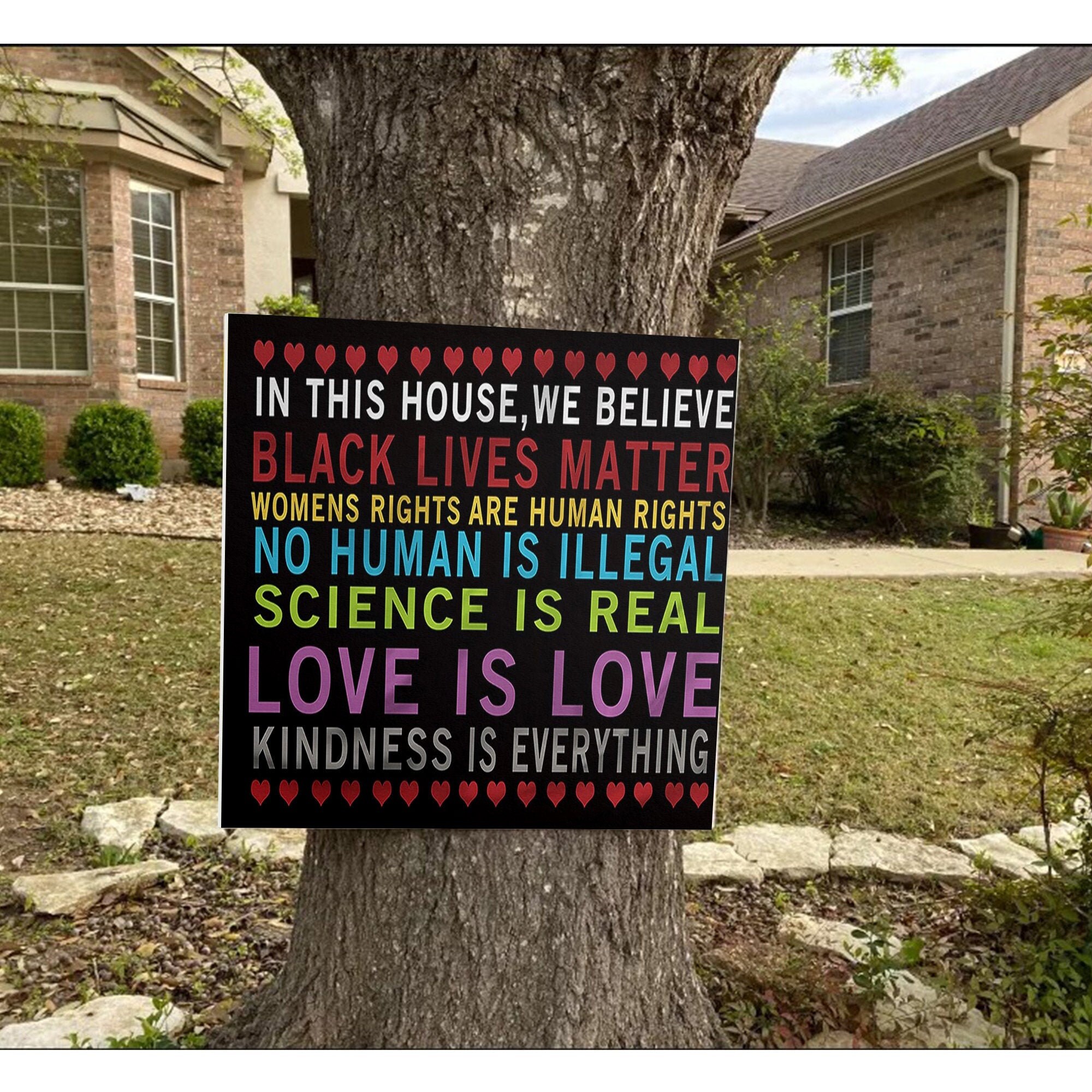
We Believe is a yard sign created as a response to Donald Trump's victory in the 2016 United States presidential election. The sign was originally designed by Kristin Garvey, a librarian from Madison, Wisconsin. The signs became popular among American liberals during Trump's presidency. Rosen Heinz still proudly displays the sign outside her home.
Popularity
The sign became an iconic symbol of progressive allyship and inclusivity. It signaled “safe space zone,” though I often wonder if a conservative, traditional-sex-ethic-believing Christian like me would also be welcome there. Still, the sign stands as one of the more enduring legacies of Trump-era resistance. As a political credo, it is more bold and memorable than anything the Democratic party has come up with in the last four years. Whether its central message survives, or collapses into a thousand more personal versions, the sign has already done a great deal of good. I haven’t seen a crocheted fuchsia beanie in years.
Sign up for our free newsletter
Don't take it from me; take it from this gay couple who decided to buy their house because someone in the neighborhood had put it out front. The sign may be just a place to start in terms of activism, but it isn't performative wokeness. It can make a genuine difference in people's lives. When the yard sign first appeared, in the wake of the 2016 election, I barely noticed it. But over the past five years, as the sign spread across the suburbs, I found myself seduced by its chaotic jumble of typefaces, its lifestyle-blog-adjacent aesthetic, its sanctimonious final line and its curious staying power.
Trump Slump
Having found one that just seemed to click with a wide swath of people, Rosen Heinz roped in a local artist, Kristin Joiner, who turned the sign we see today around in 24 hours. The black background was to help it stand out in the Wisconsin snow; it just so happened to make the rainbow-colored lines more arresting. The pair tracked down Kristin Garvey before getting their blessing to put it online. They made signs for local pickup, and offered it for download online, in return for a $5-per-sign donation to the ACLU.
But if some of you readers find the Wild Utah signs grating, you can always repurpose them to prove you’re a Democrat who loves a Republican politician more than your Republican neighbor hates a Republican politician. I get a similar feeling as I survey an ever-proliferating array of virtue-signaling lawn signage in my current neighborhood. When I was little, my neighborhood near Chicago was part of a program where families could put an orange handprint in their front window, signaling to kids in trouble that they could knock on their door to get help. The original In this house mantra has basically the same problem. Her homemade sign went viral on Facebook, and then it went into mass production. I’d guess not one in a million adopters of her creed knows her name, though she wrote the very words by which they publicly define themselves.
We all know the best way to influence federal policy is through yard signs in Utah
In This House We Believe in Keeping People Safe - Reason
In This House We Believe in Keeping People Safe.
Posted: Thu, 01 Feb 2024 08:00:00 GMT [source]
So at the end of the day, the case that prosecutors brought was only about two women. The lyrics also ring true to the details of Lambert’s life growing up in the house that built her. But Allen loves the process, and he is very patient. Really, if you look back at anybody's career, even Billy Joel or Paul Simon, it's still a handful of songs that really defines a career. Once it was finally up to par, it only took one listen for Lambert to want to record the song, but according to Douglas, the story of her first hearing it might be slightly embellished. He told the story to Bart Herbison, executive director of Nashville Songwriters Association International.
Kristin Garvey is hardly what you'd call a political activist. She's a soft-spoken youth services librarian in Madison, Wisconsin, and a mom of two. When the story of the sign is told, she shies away from taking credit. "I've never been real comfortable," she says, "because I don't feel like I did much."
Easter Week in Real Time
People wanted versions that began "in this school" or "in this apartment." The "in this house we believe" meme — which uses ASCII art and a variety of humorous slogans — also appears to date to mid-November 2016. Though no one is quite sure whether it has any connection to what was now known as the Kindness Is Everything sign, it's quite a coincidence. For the fiction section of the library, she purchased more books with more diverse characters; for the nonfiction section, more tomes on Black history and activism. She took an 8-week online course on Black history called Justified Anger — which is why she says that if she was writing the sign now, she would probably add "anger is justified" at the bottom.
Behind the Song Lyrics: “Rolling in the Deep,” Adele
Every line has a major dogma in view, and to correctly interpret the entire statement requires a high degree of political knowledge, just as something like the Apostle's Creed points Christians to larger theological doctrines. The commentary about climate change, evolution, and/or vaccines intended by "Science is real," for example, cannot be gleaned from the text itself. "Women's rights are human rights" does not mention abortion or suffrage or sexual assault, though it certainly seems intended to address all three. In predominantly white, progressive, upper- or middle-class neighborhoods, it's rare to find a block without one — or five. They're not campaign signs — those are tellingly few.
But this was a personal to-do list as much as a statement of solidarity. Garvey knew there were more steps to be taken than simply putting out a sign. "I'm not someone who can speak out eloquently," she says. "I just put the sign in my yard for myself, to remember that I need to do the research, and to remind my kids." The first point of research, the one she admits she knew the least about, was Black Lives Matter. Little did I know that the sign had originated thousands of miles away, earlier that month, as a collaborative effort by a group of Wisconsin women whose story I tell below. Nor did I suspect how viral it would go, that it would be placed in yards around the world, or that it would have such longevity.
It’s the women who are the narrators of this story now, and that won’t be overturned. So in a way, you’re saying that the story is much bigger than those criminal allegations against Weinstein. But underneath, there is this whole culture of men abusing their power, against women in particular, in the workplace. They say things like, I lost opportunities because of this, or, I could never work in Hollywood again. And they say, my whole life is different because of that. And it’s just not something that any criminal court is quite built to capture.
He made Matt Damon, Quentin Tarantino, a lot of producers who are very successful now. But what we now know is that he also used that superpower to manipulate and hurt women. In story after story about Weinstein, the same motifs come up. So those majority-opinion judges simply say that this was a kind of overreach by the prosecutor, that this isn’t how the criminal justice system works.
A friend of Rosen Heinz in Texas had a running battle with a neighbor who kept taking it down, saying it violated the HOA rules on political signage. But the HOA rules had nothing to say about flags. "So she got the biggest-ass flag you can find" with the message on it, Rosen Heinz says.


Comments
Post a Comment